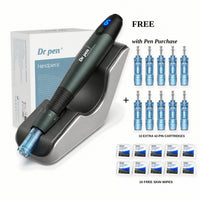
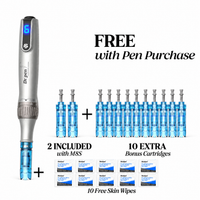

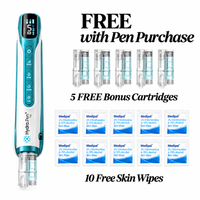

A microneedling pen with a replaceable battery can be easier to maintain over time, but only if the replacement is genuinely available and approved for that exact model. “Cordless,” “rechargeable” and “replaceable” describe different things. A pen may work wirelessly yet still require manufacturer servicing when its internal battery wears out.
The best buying decision starts with three questions: Who can replace the battery, where will you get the correct replacement and what does the manufacturer permit? Runtime matters, but a long battery-life claim is not a substitute for clear answers about servicing, compatibility and safety.
Rechargeable does not necessarily mean replaceable
Product listings sometimes emphasize wireless operation without explaining battery access. Separate the power system into these categories:
| Battery design | What it means | What to verify before buying |
|---|---|---|
| User-removable battery pack | A pack is designed to detach using the method in the instructions | Exact replacement part, current availability and approved charging method |
| Internal, service-replaceable battery | Replacement requires the manufacturer or an authorized repair provider | Service availability, shipping requirements, cost and turnaround |
| Internal battery with no documented replacement route | The seller provides no supported replacement process | Whether battery failure means replacing the whole device |
A detachable charging cable does not establish that the battery itself is removable. Likewise, a visible seam or screw is not permission to open the housing. Look for an explicit replacement procedure in the manufacturer’s documentation, not a teardown video or an assumption based on appearance.
What to verify before buying a microneedling pen
Ask the seller for the exact model manual and the battery’s replacement part number. “Compatible with Dr. Pen” is too broad to establish electrical or mechanical compatibility.
A useful pre-purchase checklist is:
- Replacement method: Is the battery user-removable, service-replaceable or not documented as replaceable?
- Replacement supply: Is the approved pack currently sold, and is there a stated ordering route?
- Charging equipment: Which adapter, cable or charging base does the manufacturer specify?
- Warranty terms: Are battery faults covered, and are ordinary capacity loss and accidental damage treated differently?
- Service access: Can the seller explain how battery-related repairs work in your country?
Save the answers with your order confirmation. A written response identifying the model and accessory is more useful than a general promise that “spares are available.”
Also distinguish a spare battery included in the box from long-term replacement support. Two packs may extend cordless availability today, but both will age. Future serviceability depends on continued access to the correct part or a documented repair service.
Compare usable runtime, not just a headline number
A microneedling pen advertised with several hours of battery life may have been tested under conditions that differ from actual clinical use. Unless the manufacturer explains the test, treat that figure as a specification to investigate rather than a guaranteed working duration.
Ask whether the quoted runtime reflects idle operation or operation under a defined load, which settings were used and how long a full recharge takes. Battery age and storage conditions can also affect usable capacity.
For professional settings, the practical question is whether the power arrangement supports the planned workflow without relying on an unexpected mid-procedure charge. A manufacturer-approved spare may help, but only when the instructions permit exchanging it and explain the required handling.
Do not assume the pen can operate while charging. Corded operation and charging are separate capabilities. A cable in the box proves neither that treatment while connected is permitted nor that every USB power source is suitable.
If a seller cannot clarify these points, compare the documented power options rather than choosing the largest runtime claim.
Check battery compatibility separately from cartridge compatibility
Battery fit involves more than whether a pack slides into the housing. Voltage, electrical contacts, charging circuitry and physical locking arrangements must match the manufacturer’s requirements.
Matching a printed voltage or capacity is not enough to establish compatibility. Avoid generic cells, improvised adapters and third-party claims that are not supported by the device manufacturer. Do not open a sealed pack or attempt to rebuild it.
Cartridges require a separate compatibility check. A battery that fits one model does not tell you anything about which cartridges that model accepts, and a familiar cartridge connection does not establish battery interchangeability.
When comparing a microneedling pen across sellers, record the complete model designation and any revision information available. Similar names, shared branding and a similar-looking casing do not prove that accessories are interchangeable.
This distinction also makes customer support more effective: provide the device label information when asking about a power accessory, and identify the cartridge separately when asking about consumables. Photographs of the relevant labels can help the seller resolve ambiguity before purchase.
Calculate ownership costs beyond the first battery
A lower purchase price can become less attractive if a worn battery requires an expensive service shipment or replacement of the entire device. Conversely, a removable pack offers little financial advantage if genuine replacements are unavailable.
Compare the same ownership categories for every shortlisted model:
| Cost category | Question to ask |
|---|---|
| Initial equipment | What power accessories are actually included? |
| Replacement battery | Is there a current price for the exact approved part? |
| Battery servicing | Are labor, shipping or inspection charges separate? |
| Consumables | What do the correct single-use cartridges and required barriers cost? |
| Downtime | Would a battery fault interrupt the intended professional workflow? |
The useful comparison is purchase price plus expected consumables, supported battery replacement and servicing, not purchase price alone. Do not assume a warranty guarantees a particular runtime throughout the device’s life; read the actual coverage and exclusions.
For a clinic opening or expanding, keep unrelated setup expenses separate. Branded uniforms sourced through a custom apparel manufacturer such as Arcus Apparel Group belong in the clothing budget, rather than being bundled into the equipment comparison. Separating those costs makes competing device quotes easier to assess.

Build a model shortlist without guessing about battery features
If you are considering the Dr. Pen A20, M8S or A11, verify each model individually. A feature described for one model should not be transferred to another, and the contents of a particular kit should be confirmed before ordering.
Start with the Dr. Pen A20 product information if that model is on your shortlist, then request the applicable instructions and confirmation of its supported battery-service arrangement. Product positioning alone does not establish that a battery is user-replaceable.
For every microneedling pen you compare, create a short record containing the model name, power configuration, approved replacement part or service route and compatible cartridge family. Leave an entry marked “unconfirmed” rather than filling a gap with information from another listing.
For a broader check of intended use, documentation and device identity, Dr. Pen Store’s guide to evaluating a microneedle medical device before buying complements this battery-focused comparison.
A seller who can identify the exact replacement route is more useful than one who simply describes the device as rechargeable.
Battery convenience does not establish treatment safety
A removable battery does not make a device appropriate for home treatment. In the United States, the FDA’s guidance on microneedling devices states that it has not authorized microneedling medical devices for over-the-counter sale.
For any microneedling pen, verify the exact device’s regulatory status, intended user and authorized indications. An FDA establishment registration or device listing is not the same as FDA clearance, and a clearance claim should not be generalized across an entire brand.
Battery handling also needs to fit the device’s cleaning and infection-control instructions. Follow the specified shutdown procedure before an authorized battery exchange. Do not handle clean supplies after touching a charger or other potentially contaminated surface without restoring the required hand hygiene and protective setup.
Use the correct sterile, single-use cartridge for each treatment session and patient, as directed. Do not reuse cartridges or assume that ordinary skincare products are suitable for freshly needled skin. The FDA has not cleared microneedling devices for use with another product, such as creams, cosmetics or platelet-rich plasma.
If a battery becomes swollen, leaks, smells unusual or heats abnormally, stop using and charging it. Contact the seller or manufacturer for handling guidance and follow local battery-disposal requirements. Do not puncture it, force it into the housing or continue using it to finish a session.
Frequently asked questions
Is a removable battery always better than a built-in battery? No. A removable pack can simplify replacement, but a well-supported internal battery may still have a practical service route. Availability, compatibility and manufacturer support matter more than the label alone.
Can I use a higher-capacity battery for longer runtime? Only if the manufacturer explicitly approves that exact replacement for the model. A similar appearance, matching voltage or larger capacity rating does not establish that it is safe or compatible.
Can I use my microneedling pen while it charges? Only when the model’s instructions expressly allow connected operation with the specified power equipment. Do not infer this capability from a USB port or included cable.
Does replacing the battery void the warranty? Check the written terms. An approved user-removable pack and unauthorized opening of a sealed housing are different situations. Ask the seller to explain coverage before purchase rather than assuming either is protected.
What if the battery fails during treatment? Stop and follow the device’s shutdown and handling instructions. Do not improvise a power connection or exchange procedure. Any subsequent treatment decision should follow the manufacturer’s instructions and the treating professional’s judgment.
Confirm the replacement route before ordering
The strongest choice is not necessarily the pen with the longest advertised runtime. It is the model with a documented power system, an accessible approved replacement or service route and clear instructions for its intended user.
When contacting Dr. Pen Store, include your shortlisted model and country. Ask for confirmation of battery replaceability, the approved accessory or repair route, warranty coverage and cartridge compatibility before you place the order.