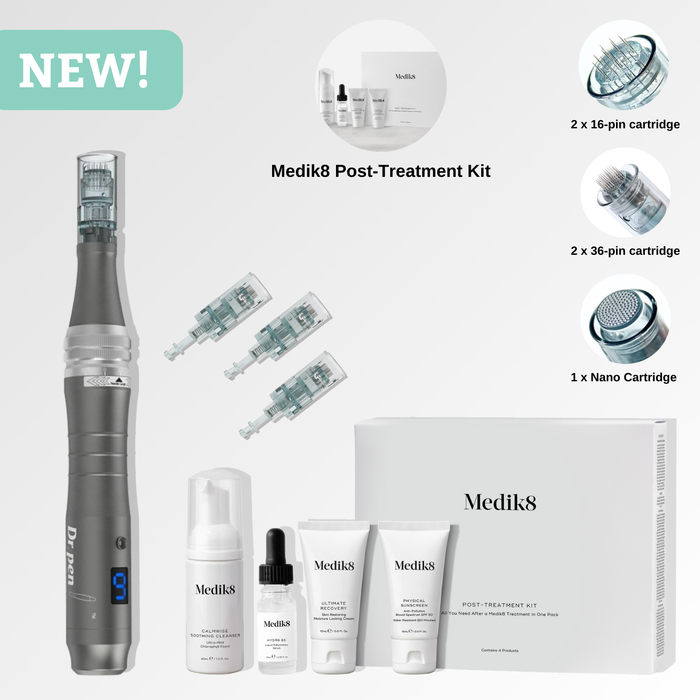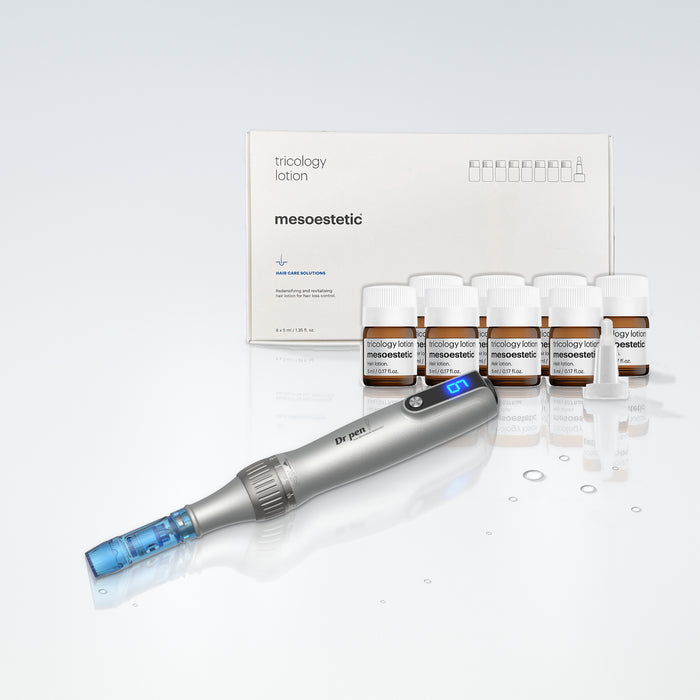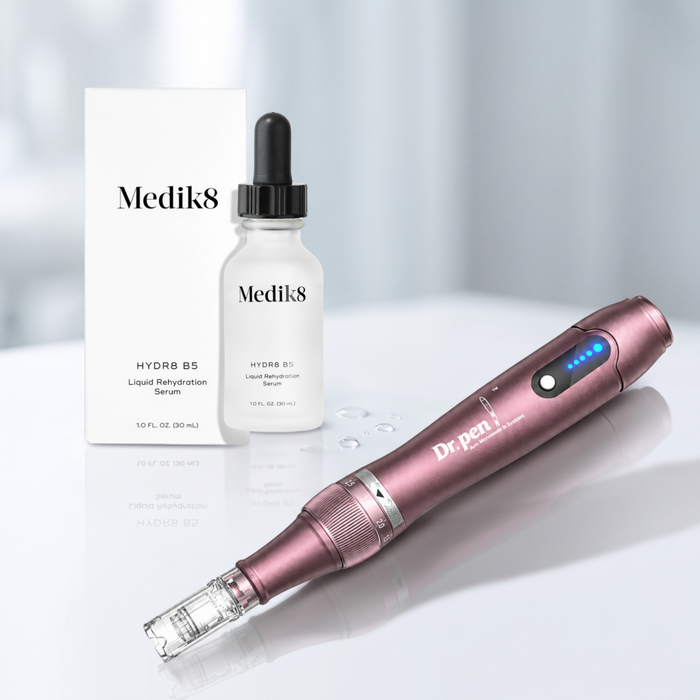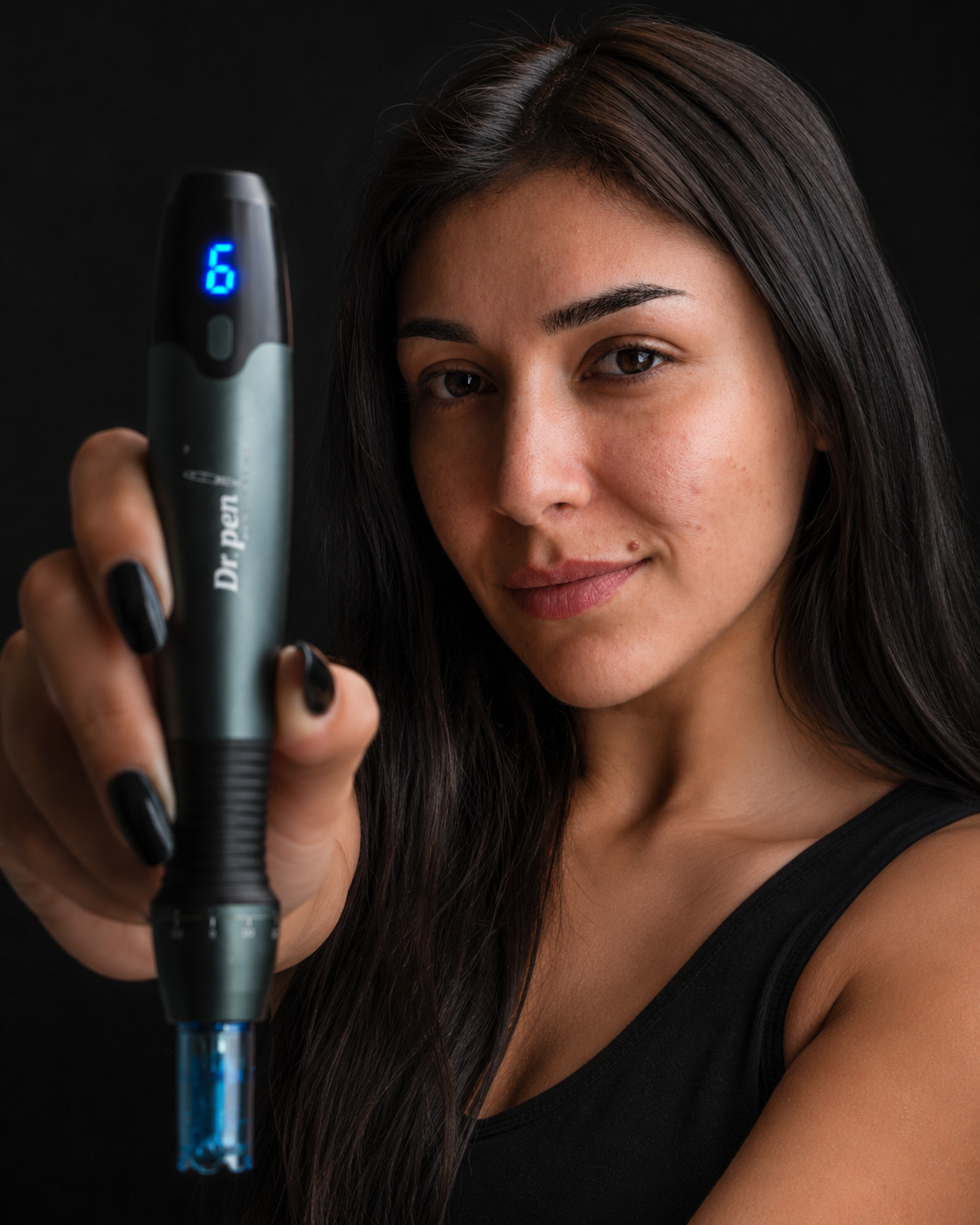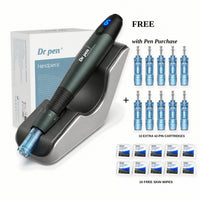
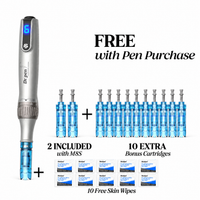

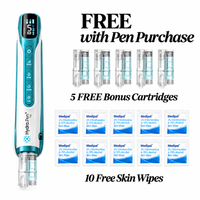

A derma needling roller and a microneedling pen can both look compact, but they behave differently around facial contours, small scars and hair-bearing skin. A roller needs room for its wheel to rotate, while a pen uses a localized cartridge with needles that move in and out. That difference can make a pen easier for a trained practitioner to position in a confined treatment area. It does not make every hard-to-reach area safe to needle.
The useful comparison is about contact, visibility and control, not simply which device has more needles or adjustable settings.
The short answer: pens offer more localized placement
For a small, clinically appropriate treatment area, a pen generally offers more localized placement than a broad roller head. Its cartridge can be positioned without needing the same rolling path across adjacent skin.
A roller is mechanically simpler and may fit a broad, relatively flat surface more easily than a narrow contour. However, its wheel and supporting frame can obstruct access beside the nose or along curved boundaries.
Neither tool should be chosen just because it can physically reach a spot. Eyelids, lips, irritated skin and raised lesions are not targets for improvised home treatment. The device’s intended use and a clinician’s assessment matter more than accessibility.
Where a derma needling roller loses precision
A roller carries needles around a rotating wheel. To maintain contact, that wheel needs a continuous path across the skin. Around a tight curve, the contact area can change as the device moves, and the frame may reach neighboring skin before the wheel sits where intended.
This becomes relevant when the goal is to address a small area without repeatedly passing over surrounding tissue. A wider head covers more ground, but that is not automatically helpful near a treatment boundary.
Pressing harder to compensate for awkward contact is not a solution. It can increase injury without making placement predictable. Likewise, a listed needle length does not tell you exactly how deeply each needle will enter under different pressure, angles and skin conditions.
What changes with a pen
A powered pen uses a cartridge whose needles move back and forth rather than around a wheel. The clinician can position that cartridge over a localized area, although the cartridge rim and pen housing still occupy space.
Compared with a derma needling roller, a pen can offer finer placement around an appropriate treatment boundary. It still requires adequate visibility, stable contact and model-specific technique. A small cartridge is not permission to work closer to the eye or onto unsuitable tissue.
For a related comparison, our guide to manual skin stamping and microneedling pens explains how localized placement differs from rolling. Manual stamping and powered pen treatment are not interchangeable procedures.
Comparing common hard-to-reach areas
“Hard to reach” includes several different problems: a narrow space, a curved surface, moving skin or hair that interferes with placement. Identifying the actual obstacle is more useful than choosing a device by size alone.
| Area or situation | Roller limitation | Pen consideration |
|---|---|---|
| Cheek beside the nose | The wheel and frame may bridge the contour rather than contact the intended patch evenly | A localized cartridge may be easier for a clinician to position, but the site must be appropriate for treatment |
| A small scar within otherwise unaffected skin | The rolling path may include surrounding tissue | Placement can be more focused, although scar type determines suitability |
| Curved chin or jawline | Contact changes as the wheel crosses the curve | Stable contact and visibility remain necessary |
| Hair-bearing scalp | Hair can obstruct the wheel or become caught | Hair can still interfere with cartridge access; hair-loss treatment needs a separate clinical assessment |
| Eyelids, lip tissue or a raised mole | Physical access does not establish safety | A smaller tip does not make these suitable for self-treatment |
Around the eyes and mouth, reach is not the deciding factor
Do not use a derma needling roller to experiment on eyelids, the lash line, the red portion of the lips or inside the nose. Switching to a pen does not remove the risks in these locations.
Concerns described as “under-eye wrinkles” or “lines around the lips” also need precise anatomical assessment. Skin near a sensitive structure is not the same as that structure itself, and a consumer cannot establish a safe treatment boundary from a product photograph.
A dermatologist can determine whether microneedling is appropriate at all or whether a different treatment better matches the concern.
What a specific roller’s specifications tell you
The GTS 192 Gold Derma Roller 0.5mm has 192 stainless steel microneedles mounted on a rolling wheel. Those specifications identify its needle count, material and nominal needle length. They do not establish that it will fit every facial contour or be suitable for every user.
For this comparison, its fixed 0.5 mm needle length matters more than the “Gold” product name. It is not an adjustable-depth pen. Nor should 0.5 mm be interpreted as a guarantee of painless treatment, superficial effects or a particular recovery time.
Before choosing any derma needling roller, examine the head’s width, the clearance around its frame and the manufacturer’s intended-use instructions. More needles do not necessarily mean better access: a higher count alone says little about the wheel’s footprint or how it contacts curved skin.
For pens, make the equivalent checks at cartridge level. The cartridge’s outer dimensions and compatibility matter alongside the needle configuration. Do not assume a cartridge fits because it looks similar to one used by another model.
Hygiene and device condition can rule out either option
Precision is irrelevant if the needle assembly is damaged or contaminated. Inspect a roller for bent or missing needles, corrosion, a damaged wheel and an irregular rolling action. If the needle assembly strikes a hard surface, stop using it until its condition can be assessed under the manufacturer’s instructions; tiny defects may not be obvious.
For a reusable roller, follow the stated cleaning, disinfection and replacement instructions. Home disinfection does not make a device sterile, and a roller should never be shared. If you cannot establish that it has been properly maintained, do not use it.
For a pen, use the exact compatible, intact, sterile single-use cartridge specified for the model. Use a new cartridge for each session, even for the same person. Wiping or soaking a used cartridge does not make it suitable for reuse.

Dispose of used needles and cartridges according to local sharps guidance. Store reusable equipment as directed, protected from moisture, damage and access by children.
Needle length and treatment frequency are not access solutions
A longer needle will not help a wheel fit a narrow contour. Similarly, increasing a pen’s depth setting does not compensate for poor positioning. Access and treatment depth are separate decisions.
The FDA’s microneedling device guidance distinguishes medical microneedling devices from some short or blunt cosmetic products. The FDA also states that it has not authorized microneedling medical devices for over-the-counter sale. Being available online is not evidence that a device is suitable for unsupervised use.
A derma needling roller therefore should not be assigned a treatment schedule simply from its product category. Frequency depends on the device, intended procedure, skin response and clinical plan. Daily use or repeating treatment while skin remains irritated can compound injury.
For US buyers comparing pens, check the exact model’s regulatory status and labeled indications. Clearance for one device or indication does not establish clearance for every pen, cartridge, body area or cosmetic claim associated with a brand.
Skin conditions and scalp concerns change the decision
Active acne, infection, open wounds and inflamed skin can make needling inappropriate. A history of abnormal scarring, impaired healing, bleeding problems or medications that affect healing also warrants medical review before treatment.
The American Academy of Dermatology’s microneedling overview explains potential benefits and why medical assessment matters. Selected acne scars and wrinkles may improve with appropriate professional treatment, but neither device geometry nor needle count predicts an individual result.
On the scalp, hair adds an access problem without resolving the underlying diagnosis. Shedding, pattern hair loss and inflammatory scalp disease need different management. Choosing a derma needling roller because it can pass through a part in the hair does not establish that needling will help.
The FDA has not cleared microneedling devices for hair-loss treatment or for delivering topical drugs or cosmetics into the skin. Do not treat a pen or roller as a way to push minoxidil, ordinary serums or other products deeper.
Know when irritation needs medical attention
Follow the treating clinician’s aftercare plan rather than adding exfoliating acids, retinoids or fragranced products to freshly treated skin. Protect recovering skin from sun exposure as directed.
Seek prompt medical advice for increasing pain, spreading redness, warmth, swelling, pus or fever. Eye pain, visual changes or accidental injury near the eye require urgent assessment. Persistent darkening, lightening or raised scarring also deserves evaluation rather than another treatment session.
A practical buying checklist
Once a clinician has established that treatment is appropriate, compare the equipment against the actual location and procedure rather than choosing the smallest-looking device.
- Treatment footprint: Check wheel width and frame clearance for a roller, or cartridge diameter and housing clearance for a pen.
- Intended use: Confirm that the device instructions cover the planned procedure and user setting.
- Replacement supplies: Verify the exact cartridge model or the roller’s replacement requirements before purchasing.
- Authenticity and support: Look for manufacturer-verifiable authenticity and access to model-specific instructions.
A derma needling roller may be mechanically straightforward, but a pen may offer more localized placement for a trained operator. Neither advantage overrides skin suitability, hygiene or professional judgment.
Frequently asked questions
Is a pen always better than a roller around the nose? A pen’s localized cartridge may be easier for a clinician to position beside the nose. That does not make the nose, nostril margins or every nearby concern suitable for needling.
Does a 0.5 mm roller count as harmless home skincare? No. The nominal needle length does not guarantee harmless use or predictable penetration. Skin condition, pressure, device quality and hygiene all affect risk.
Can I use a smaller roller instead of a pen? A smaller wheel may change access, but it does not establish safety or produce the same needle movement as a powered cartridge. Check intended use rather than treating size as the deciding specification.
What should go on the skin before treatment? Follow the treating clinician’s preparation protocol and the device instructions. Do not improvise with household disinfectants, numbing products or cosmetic serums intended for intact skin.
Choose by treatment area, then verify the device
For a hard-to-reach area, start with whether the skin should be treated, then assess the contact footprint and required control. A derma needling roller needs a rolling path; a pen offers localized placement but still requires appropriate technique and safeguards.
When comparing Dr. Pen devices and replacement cartridges, verify the exact model, intended use and compatible supplies before ordering. If the target area is close to the eye, lip tissue or an unexplained lesion, get a clinical assessment before buying equipment for it.